
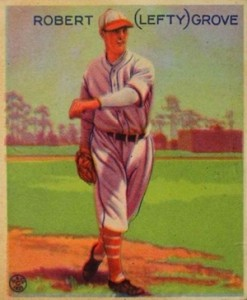
Next up at #21 is Philadelphia A’s and Boston Red Sox ace Lefty Grove. There is no question that Grove is on the shortlist of greatest pitchers of all time. Depending on what we emphasize, he might be the greatest. No pitcher led the league more in major statistical pitching categories. He led the league in ERA and adjusted ERA+ nine times, WAR for pitchers eight times, and winning percentage five times—all the most in history. Grove won the 1931 AL MVP during this stretch with one of the great seasons ever recorded by a pitcher, going 31-4 and leading the league with a 217 ERA+. Grove’s 1931 season is the only one in history with at least 31 wins and fewer than 5 losses. Although the Cy Young Award didn’t exist during Grove’s career, there’s every reason to believe that he would’ve won six consecutive Cy Youngs from 1928-1933 which would be two more than the current record for consecutive Cy Youngs. During this stretch, he became the only pitcher in history with six consecutive seasons of at least 20 wins and no more than 10 losses. Grove compiled four seasons with at least 24 wins and fewer than nine losses which is the most all-time. No other player has more than two. There have only been four seasons with at least 28 wins and fewer than six losses in history, Grove has two of them. He’s the only pitcher in history with four consecutive seasons of at least 24 wins and no more than 10 losses. He’s the only pitcher in history with 300 wins and fewer than 150 losses, and he has the highest winning percentage in MLB history among pitchers with at least 240 career wins. He owns the highest ERA+ of all-time among pitchers with at least 3,000 career innings. Grove led the Athletics to three consecutive World Series appearances including back-to-back titles in 1929 and 1930. In 51 1/3 and World Series innings, he posted a 1.75 ERA and a 1.01 WHIP.
I think this is spot on. Grove had two peaks of over 40. 0 in give years using bWAR. He is the only pitcher to do it. This is partially because innings pitched totals dropped after 1920 due to the live ball and the idea that a fat pitch became a home run and not “maybe” a warning track flyball for one of the outfielders.
Also. Grove had virtually the same ERA at home as on the road and he pitched his entire career in extreme hitter’s parks, Shibe Park in Philadelphia and Fenway Park in Boston. His ERA was 3.06 which is also his birthday.
Also, Grove came to MLB late, but he had 13 consecutive outstanding seasons mot counting a sore armed 1934 season. From 1926-39 he was 268=108 with a 2.75 ERA and an 8.14 WAR/250, better than Sandy Koufax 7.61 from 1963 through 66.
He won four ERA titles in five years in Shibe when he was a power pitcher; he won four ERA titles in five years as a finesse pitcher with the Red Sox with the Green Monster looming over his shoulder.
Also Grove came at the greats of his era. He struck out Babe Ruth 45 times and only walked him 13 times in 135 official at bats and 148 plate appearances
Baseball scholars and experts see him as one of the two or three best pitchers of all time. He is definitely no lower than third. Also, remember in 1928 he pitched two immaculate innings (meaning he threw nine pitches and got three (3) strikeouts; the strikeout per game average for the American League in 1928 was 3.00.
Well said, Joe. The only thing holding him back in the GOAT conversation is the same thing holding back everyone from his era, and that’s quality of competition. Nothing he could’ve done about that.