
Why is Alexander Ovechkin the 2nd Greatest Hockey Player of All-Time?

Wayne Gretzky is not only the greatest hockey player of all-time, but also the greatest athlete that the four major North American sports have ever produced. The gap between “The Great One” and everyone else in hockey history is as deep as, well, the ‘87 Oilers. That second spot, though, is up for grabs. There are compelling arguments to be made for Mario Lemieux, Gordie Howe, Bobby Orr, Patrick Roy, and even Sidney Crosby. The most compelling argument, however, goes to a player who is often dismissed from the conversation altogether, and that’s Alexander Ovechkin. There are flaws on Ovechkin’s resume. In fact, every player listed above has a major flaw on their resume. Lemieux was hardly a defensive stalwart, and he had just six seasons in which he played more than 67 games. Howe played in a league with six teams, which made his path to awards and championships the easiest of anyone in the conversation. Crosby was robbed of parts of several prime seasons due to concussion symptoms, and he has the fewest Hart/Vezina trophies of the group. Orr was essentially done by age 27, and played in the expansion era, which was the weakest in the history of the NHL. Roy won only half as many Vezinas as a rival goaltender (Dominik Hasek). They all have flaws. Aside from the very real North American bias that exists in these conversations, any “hate” (or let’s call it “lack of love”) for Ovechkin at the second spot exists under the mistaken assumption that a flawless candidate exists.  

Goals are the goal

Before we move to Ovechkin’s resume, let’s tackle the biggest criticism that gets levied against him: “he’s just a goal scorer.” First, that’s not close to being true–and we’ll get to that shortly–but even if it were, there comes a point when an athlete is so superior at the most important skill in a sport, that none of the other stuff matters. Michael Jordan is the greatest scorer in the history of the NBA. He has the highest scoring average of all-time and led the NBA in scoring a record 10 times. Nobody in the modern era has ever come close to matching Jordan’s scoring. Nobody is out there dissing Jordan’s scoring because he never finished in the top 5 in assists. Alexander Ovechkin has led the NHL in scoring a record nine times. Nobody in the modern era of hockey has ever come close to that. We’re not talking about a good goal scorer, we’re talking about, by far, the greatest goal scorer of all-time, and that distinction has little to do with his status as the NHL’s all-time leading goal scorer, and everything to do with how much more he dominated his era than any player in history. The obvious counter is to point out that Jordan won six championships to Ovechkin’s one. However, Ovechkin’s competition hardly has Jordan-esque championship totals themselves. Lemieux and Orr seem to be the most popular choices at the second spot, and they each won two championships. They also had the luxury of playing with Jaromir Jagr and Phil Esposito–two of the top 20 greatest players of all-time–among others. Ovechkin has had no such luxury with Washington.   

Points are flawed

Now, about that “just a goal scorer” criticism, which is just code for “doesn’t have huge point totals.” Hockey fans–me included–have a bad habit of obsessing over “points.” I was admittedly ecstatic when Connor McDavid became the first player since 1996 to reach the 150-point mark in game 80 of the 2022-23 season, and then again when he landed right on 100 points in the last game of the season in 2024-25 to extend his 100-point streak to five seasons. Points are fun. However, the fact that a goal, a primary assist, and a secondary assist are viewed equally is an absurdity. The second assist (which accounts for roughly half of all assists) often has little to do with the outcome of a play, and probably shouldn’t even exist (I mean, why not add a 3rd assist?). Even many primary assists are harmless passes that have little to do with the puck going in the net. If assists were fairly valued in the point tally, we wouldn’t even be having this conversation; Ovechkin would be the near unanimous choice. Let’s imagine that world–a world where the creator of the “points” statistic took an extra second to think about whether it made sense. Let’s imagine that a primary assist is worth ½ of a point, and a secondary assist is worth ¼ of a point (rough estimates of what fair values could be). Assuming there are as many primary assists as secondary assists, the average assist would equate to .375 points. This is what that world would look like:
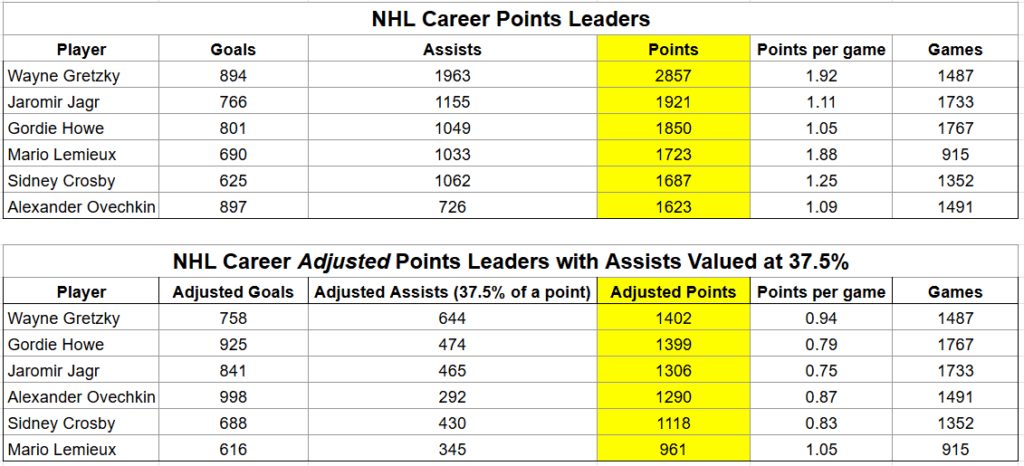

With assists being fairly rated in the points statistic, nearly all of the concerns about Ovechkin’s point totals would be erased. He’d carry a clear points per game advantage over Howe, and his massive longevity advantage over Lemieux would be represented by a 300+ margin in career points. He would have a points lead over Crosby, who some view as the superior player simply due to his point totals. In that world, Ovechkin isn’t even overwhelmed by Gretzky’s production. The numbers in the table above represent a world where points are adjusted for league scoring pace and assists are valued fairly. This is much closer to reality than simply heading over to the points leaderboard and regurgitating a flawed statistic to devalue the greatest goal scorer in NHL history. The point of the game is goals after all, and Ovechkin is the greatest there ever was:

——————————————————————————————————————–

Ovechkin’s Goal Dominance

1). Led the NHL in goals 9 times which is the most in NHL history. No player to debut since 1979 has done it more than 3 (!!!) times.

2). No player has even finished in the top-5 in goals more than 6 times since 1979.

Editor’s Note: This is my favorite Ovechkin statistic. 

3). Finished top-5 in goals 15 times, which is the most in NHL history. No player since the Original Six has done it more than eight times. 

4). Most adjusted goals in NHL history (999), 74 ahead of 2nd place (Gordie Howe), 158 ahead of 3rd place (Jaromir Jagr), and 241 ahead of 4th place (Wayne Gretzky).

5). Most seasons with 50+ adjusted goals (11). Nobody else has more than seven (Rocket Richard), and nobody since the Original Six has more than five. 

6). Most seasons with 40+ adjusted goals (16). Nobody else has more than 10 (Gordie Howe and Brett Hull). Gretzky and Lemieux have 15 combined (!!!)

Editor’s Note: This is my second favorite Ovechkin statistic.

7). Highest adjusted goals per game in NHL history (.67, tied with Mario Lemieux) despite playing in 575 more games than Lemieux (since 1935).  For perspective, Bobby Orr’s entire career lasted 657 games. 

8). Only player in the history of the NHL to be voted an NHL First Team All-Star at left and right wing.

9). Most NHL First Team All-Star selections (8) by a forward since the Original Six (tied with Gretzky).

10). Led the NHL in Power Play goals a record six times. No player since the Original Six has done it more than three times. 

11). Only player in NHL history to lead the NHL in Power Play goals and Even Strength Goals five times each. 

12). One of only four players in NHL history to win three Hart Trophies and a Conn Smythe Trophy.

——————————————————————————————————————–

Complete Player

Critics like to skewer Ovechkin for not having an “all-around game” in favor of Gretzky, Lemieux, and Crosby. Ostensibly, this means “doesn’t have a ton of assists,” but it really just ends up being a catch-all attempt at hand-wavery and selective reasoning meant to discredit Ovechkin. There are, of course, one-dimensional players, but Ovechkin isn’t one of them, and to compare his responsibilities to that of centers is the surest sign that an argument is not being made in good faith. Ovechkin plays a different position! He is every bit the all-around player as a winger that the aforementioned players were as centers. There has never been a modern elite offensive player who has come close to matching Ovechkin’s physicality. He is the all-time leader in hits among forwards in league history. He has more than three times as many career hits as Crosby, and, remarkably, he managed to do so while accruing fewer career penalty minutes than both Crosby and Lemieux despite playing ~140 and ~600 more games, respectively. Ovechkin is also an uncommonly strong defensive player among elite goal scorers. He has more defensive point shares than the top 10 goals scorers in NHL history with the exception of Jaromir Jagr. Ovechkin’s durability and availability is also unparalleled among elite offensive players. He played at least 79% of Washington’s games in every season of his career. Lemieux had 10 seasons in which he did not reach that mark, and Crosby had 5. When talk turns to Ovechkin lacking an all-around game, these aspects of his repertoire are conveniently left out. Ovechkin’s combination of elite goal scoring, physicality, defensive presence, and durability has never been seen before in NHL history.

Conclusion

While Ovechkin has the second most impressive resume in history, it’s not by a significant margin. The difference between Gretzky and Ovechkin is larger than the difference between Ovechkin and anyone in the top 15. It’s more likely than not that Lemieux would’ve had a superior resume had he been afforded the luxury of Ovechkin’s health, and that could be true for Crosby as well. That makes Connor McDavid a very interesting player to follow over the next 10 years. He has an opportunity to fully realize his career potential the way Lemieux and Crosby could not. If that happens, and he’s able to win a Stanley Cup or two, then Ovechkin’s hold on the second spot starts to become perilous. Until then, Ovechkin has the best case of a group of flawed resumes (relatively speaking, of course).

Why is Wilt Chamberlain Not in the GOAT Conversation?

If you are a basketball fan, chances are you have either believed at one time or still believe that Wilt Chamberlain is on the Mount Rushmore of professional basketball. Part of the reason you believe this is because he did things like score 100 points in an NBA game and average 50 points over an entire season. These feats are pretty spectacular. The other part of the reason you believe this is because people who don’t understand how much competition level matters tell you it’s true. So, it must be, right? Well, I’ll let you decide, but for all his exploits on the court, Chamberlain had the largest decline in career scoring average from regular season to playoffs in NBA history, played in a league that had just nine players who were taller than 6’9, and shot just 50% from the field during his record breaking season, including a meager 46.7% in the playoffs, despite playing against, by far, the weakest competition in NBA history. In fact, it wasn’t until he cut his field goal attempts in half during his age-30 season that his teams started to have success in the playoffs. Yes, all of those record breaking offensive achievements likely prevented playoff success. There are several players in NBA history who would have had little problem matching Chamberlain’s scoring prowess had they been afforded 40 shots per game by their head coach, and they likely would’ve done so with a much higher shooting percentage. This isn’t a Wilt thing, it’s an era thing. Chamberlain was the greatest player of a really flawed era. 

Let’s get right into the ugly underbelly of Chamberlain’s competition. We cannot begin any conversation about Chamberlain’s status on the all-time list without loudly and emphatically stating that he did his cooking on “easy mode.” He was not only the tallest player in the NBA, but he was also at least three inches taller than 92% of the league, and at least six inches taller than 78% of the league. In fact, there were only nine players in the NBA who were taller than 6’9 in 1962. By 1982, that number had ballooned to 73. Height is a physical trait, not a skill. Yet, 21 of the first 25 NBA MVPs played center. That says quite a bit about what was important in the NBA in the 1960s. As the league became more skilled, being tall stopped mattering as much. Starting with Larry Bird’s MVP in the 1983-84 NBA season, 34 of the next 37 NBA MVPs were not centers. Magic and Bird ushered in the era of skill, and the league has not looked back. Chamberlain was tall and athletic, and that was largely it. NBA competition was so watered down in the 60s that being tall and athletic was the only prerequisite to dominating the league. It is not hyperbole to suggest that DeAndre Jordan would have been a monster in the 1960s.  Footwork, skill, handles, and high-efficient shooting were merely a pipe dream. Chamberlain exclusively played within 10 feet of the basket because he had to. Consider he shot just 51% from the free throw line despite having nearly 12,000 attempts to figure it out. That’s worse than Shaq! 

Now, about that 100 point-game and 50-point scoring average.  On March 2, 1962, Wilt Chamberlain scored 100 points in an NBA game against a New York Knicks team that had just one player in the starting lineup taller than 6’6 (Cleveland Buckner, 6’9). Chamberlain hoisted a ludicrous 63 field goal attempts along with 32 free throw attempts, which means he took roughly 80 shots from the field if we include shot attempts in which he was fouled. Nobody has ever come close to taking that many shots in a single NBA game. In fact, Chamberlain missed 27 shots. Michael Jordan and LeBron James never averaged 27 shot attempts in their entire careers. For perspective, David Robinson entered the final game of the 1993-94 regular season in a razor-close battle with Shaquille O’Neal for the league scoring title. Robinson dropped 71 points largely by being force-fed the ball, just like Chamberlain’s teammates did in 1962. In a significantly more competitive NBA landscape, Robinson was much more efficient in his 71-point game than Chamberlain was in his 100-point game, beating him not just in field goal percentage (63.4% to 57.1%), but also in True Shooting % (68.3% to 64.9%). Robinson also scored 63% of San Antonio’s points compared to Chamberlain scoring 60% of Philadelphia’s. Several players throughout the history of the NBA had the talent to score 100 points in a game had they been gifted 80+ shot attempts, and many would’ve done it more efficiently. Robinson’s 71-point game provides a glimpse of that. The reason NBA teams don’t allow players to shoot that many times in a game is because it’s inefficient against good defenses. Chamberlain’s playoff success, or lack thereof, supports this.

Chamberlain took a lot of shots, and he missed a lot of shots. This is best exemplified by the 1961-62 season in which he averaged an NBA single-season record 50.4 points per game. While he chucked shots in 1962 like nobody before or since, he also missed a remarkable 1,562 shots, which is, by far, the highest total in NBA history. Nobody else has even missed 1,300 shots in a season. Chamberlain’s field goal percentage during his record-setting season was just 50.6%, despite shooting almost exclusively within 10 feet of the basket and playing against players who were several inches shorter than he was. That percentage would be borderline unplayable for a high-volume center in today’s NBA.

In the early days of the NBA, the league was regional, and the money was not lucrative. This resulted in a small talent pool to draw from. To water the league down even more, unofficial racial quotas made the league largely inaccessible to black athletes. Only 25% of the NBA was black in 1962. That number has been steadily above 70% since the late 70s. Chamberlain feasted on this compromised league and, even then, his numbers plummeted when it mattered most. Consider his career regular season scoring average was an impressive 30.1 points, but his playoff scoring average fell to just 22.5 points. While the league overall was competitively weak, there were good teams with legitimate defenses. These teams made life quite difficult for Chamberlain despite the fact that he was the most physically gifted player in the league by leaps and bounds. Modern basketball players prove every day that there’s more to the game than size and athleticism. That was true even in the 1960s as the Boston Celtics proved repeatedly throughout Chamberlain’s career. For all his dominance, Chamberlain was just 1-7 in playoff series against the Celtics.  

Wilt Chamberlain was the greatest basketball player of all-time once upon a time. He was the king of his era, but his era was a small pond compared to the lakes and oceans that have existed since. It’s OK to acknowledge how much better Chamberlain was than the very homogenized collection of athletes that existed in the league’s infancy. It’s also OK to rate him higher than any player from his era. In fact, it would be illogical not to. However, it is disrespectful to the sport to ignore how little skill was involved in professional basketball in the 1960s. It’s also disrespectful to the stars who have thrived in a drastically more inclusive and competitive NBA environment in the six decades since. 

Why is Hulk Hogan the GOAT?

Success in professional wrestling doesn’t look quite the same as it does in baseball or basketball, where we have the luxury of statistics to quantify greatness. Legitimate competition produces real statistics, which makes it relatively easy to surmise the true value of an athlete. Pro wrestling is different. How do we measure the greatest in an industry that is essentially physical theater? While all GOAT conversations occur in the sphere of opinion, that is perhaps most true in wrestling. If you think Macho Man was the greatest wrestler of all time, there isn’t a statistic to definitively tell you he wasn’t. In the football GOAT conversation, it’s easy to cite that Tom Brady has more Super Bowl victories, Super Bowl MVPs, passing yards, touchdown passes, regular season wins, and postseason wins than any other player in NFL history. That’s a pretty compelling argument rooted in statistics. In the wrestling world, where results are pre-determined and–even then–have little bearing on “greatness” (“Mr. WrestleMania” Shawn Michaels was 6-11 in his 17 WrestleMania matches), statistics and legitimate wins and losses are absent from the conversation. Without tangible numbers to lean on, the most logical place to hold this conversation is “industry impact.” There are several ways to define industry impact–and we should use them all–but almost every definition results in Hulk Hogan being the greatest professional wrestler of all time, and by a country mile. There is no shortage of pro wrestlers who have helped shape the industry. Ric Flair, “Stone Cold” Steve Austin, The Rock, Andre the Giant, “Macho Man” Randy Savage, and the Undertaker are just a few from recent generations who have carved out tremendous legacies. However, none of them come close to the impact that Hogan had not just on the profitability of wrestling, but on the visibility and mainstream acceptance of the industry as a whole.  

The Chosen One

Hogan began his professional wrestling career in 1977, and by 1982 he was already a powerhouse in the industry and a bona fide crossover superstar thanks to his villainous role as Thunderlips in Rocky III. Vince McMahon Jr.–having purchased the World Wrestling Federation (WWF) from his father in 1982–had his sights set on a global takeover of the wrestling industry, and he needed a lynchpin to be the face of his invasion. He chose Hogan, and he chose wisely. The value of the company would skyrocket from just one million dollars in 1982 to 14 billion dollars in 2025. Wrestling at the time was built on a territory system with dozens of regional companies scattered throughout the United States. There was an unspoken rule amongst territory owners that they would respect geographical boundaries and contracts in each territory. Of course, unspoken rules are meant to be broken, and McMahon was the first to make the move. He began enticing the biggest stars of the territories to jump ship to his company by offering lucrative contracts and mainstream exposure on a national platform. While McMahon’s vision was bold, it was not without risk, and it is difficult to imagine anyone at the time besides Hogan being able to pull it off, and pull it off he did. The tombstones of defunct wrestling territories and the massive success of WWE today are proof.

The Merchant of Merch

By 1985, the WWF was the preeminent company in wrestling, and Hulk Hogan was one of the biggest stars in the world alongside the likes of Arnold Schwarzenegger and Sylvester Stallone. He had his own Saturday morning cartoon (Hulk Hogan’s Rock ‘n’ Wrestling), hosted Saturday Night Live, and appeared at the Grammys. He was the face of NBC’s Saturday Night’s Main Event, which was wrestling’s first primetime program on network television since the 1950s, and he headlined WrestleMania I, which is arguably the most important event in the history of professional wrestling. While McMahon’s industry takeover had taken off in earnest, Hulk Hogan was turning into a megastar, a status that would only balloon with the massive successes of the WWF’s Rock ‘n’ Wreslting Connection cross promotion with MTV, WrestleMania III in 1987, and Saturday Night’s Main Event’s six-year run as a ratings bonanza on primetime television. The Brawl to End it all was the most watched program in the history of MTV at the time it aired, and Saturday Night’s Main Event was so popular that it routinely garnered larger TV audiences than Saturday Night Live. Hogan’s presence was ubiquitous, leading to a brand identity not only new to professional wrestling but to pop culture in general. Professional wrestling today is inundated with merchandise that fans gobble up en masse, but that wasn’t always the case. The whole “merch” part of the industry was pioneered by the popularity of Hulkamania. Whether it was apparel, hats, lunch boxes, foam fingers, action figures, replica belts, workout sets, if Hogan’s name was on it, it flew off the shelves. Hulkamania wasn’t just a word that Hogan used to refer to his army of fans, it described what was happening in retail stores across America. Hogan’s influence was so profound that it created a massive money-making stream that didn’t exist before in the 100+ years of professional wrestling. Ric Flair and Andre the Giant–despite being wildly popular at the time–sold virtually no merchandise. The respective spheres of influence between Hogan and everyone else are like comparing mountains to hills. In a business where success is measured by ticket sales and eyeballs, Hogan didn’t just bring visibility to professional wrestling, but a marketability that wrestling promoters of yesteryear could only dream of.    

The First Action Hero (of wrestling)

It’s not unusual to see a professional wrestler starring in a movie today. Whether it’s the Rock, John Cena, or Batista, viewing audiences have gotten used to the ring-to-reel crossover. However, that path simply did not exist until it was paved by Hulk Hogan. Hogan’s role in Rocky III gave way to appearances on popular TV shows like The A-Team, The Love Boat, Baywatch, Suddenly Susan, Walker, Texas Ranger, and Hollywood leading roles in Suburban Commando, Mr. Nanny, and No Holds Barred. He also starred in the TV series Thunder in Paradise, becoming the first athlete to star in both an animated series and a primetime television series. In the “regular” sports world, pop culture crossovers outside of the lines of competition don’t factor into GOAT conversations. Tom Brady marrying Gisele, creating TB12, or orchestrating his own roast on Netflix doesn’t impact his value as a quarterback. The same can’t be said for pro wrestling. Without real wins and losses or statistical achievements, the biggest impact a wrestler can have on the business is bringing attention to it, and there’s no bigger way to bring attention than dragging professional wrestling into living rooms and movie theaters. While football is a competition first and a product second, pro wrestling is a product first and only, and Hogan was that product’s most lucrative salesman.  

Lightning Strikes Twice

There’s no question that Hulk Hogan was the driving force behind Vince McMahon’s dream of global domination becoming reality. History is rife with agents of change who happened to be at the right place at the right time. This is a designation that could even be applied to Hogan, if he didn’t do it all over again by taking down the very company that he helped elevate, and then pushing it to the brink of bankruptcy. Hogan’s contract with the WWF expired in late 1993, and he soon signed on with McMahon’s only remaining rival, World Championship Wrestling (WCW). The addition of Hogan was a coup for WCW, which was merely trying to reach profitability in an industry dominated by the WWF. Eric Bischoff was in charge of the day-to-day decision-making in WCW at the time, and he targeted and recruited older wrestlers with name recognition like Hogan and Randy Savage. With Hogan and Savage in tow, Bischoff was able to convince Ted Turner (WCW’s owner) to challenge WWF’s stranglehold on wrestling viewership by creating a cable show on Monday nights to rival WWF’s flagship program, Monday Night Raw. This led to the creation of Monday Nitro on TNT. 

Nitro was competitive with Raw immediately, winning or tying the ratings battle in 16 of their first 26 head-to-head matchups. Despite being 42-years-old, and a decade removed from the peak of Hulkamania, Hogan’s star power was enough to guide WCW to a stalemate with McMahon. That is, until July 7, 1996, when the leg drop heard around the wrestling world was levied by Hogan. In a move that would’ve been considered unfathomable just moments before, Hulk Hogan turned heel and became the baddest of the bad guys. This reversal sent shockwaves through the ether that once again attracted attention from millions of people who had long given up on professional wrestling as a primary source of entertainment. Hogan’s shocking turn and subsequent creation of the New World Order (NWO) storyline immediately catapulted WCW to the top of the ratings. Nitro would beat Raw in the ratings for an unprecedented 83 consecutive weeks, setting off another merchandise bonanza as NWO apparel became the hottest-selling merch in the business. Hogan was doing it all over again, except this time as a bearded bad guy in black and white, instead of a mustachioed good guy in red and yellow. WCW would go on to generate more revenue than WWE from 1996-1998, which would’ve been an inconceivable notion just a few years prior. Before Hogan’s NWO angle hit, merchandise was simply not a reliable revenue stream for WCW, once again showing how influential Hogan was to the industry’s bottom line. After a decade of dwindling audiences, wrestling was cool again, with athletes and celebrities like Karl Malone, Dennis Rodman, Reggie White, Kyle Petty, Master P, and David Arquette flocking to Nitro to be a part of the show. Hogan didn’t just prove that he could change the industry once as a babyface, he showed he could do it again as a heel. Nobody has ever come close to pulling off Hogan’s double feature from each side of the good vs. evil spectrum. John Cena–arguably the most popular wrestler of the past 25 years–tried to recreate Hogan’s heel turn magic to jumpstart his 2025 farewell tour, and found out that pulling it off was no easy task. Whereas Hogan’s heel turn shook the industry at its foundation, Cena’s proved to be just another storyline.

The Final Act

The greatest moment in the history of professional wrestling is up for debate, but it might be Hogan’s showdown with Andre the Giant at WrestleMania III in front of 93,000 people. What was already a frenzy turned into full-blown Hulkamania madness as Hogan slammed Andre to the mat and emerged victorious. Another candidate, however, is the crescendo of Hogan’s final act in the WWF following WCW’s sale to McMahon in 2001. Still booked as his villainous NWO persona, Hogan was pitted against The Rock in the main event of WrestleMania X8. In a tilt that was dubbed Icon vs. Icon, the 48-year-old Hogan was meant to pass the torch to the 29-year-old superstar. However, something strange happened. On his way to doing “the honors,” Hogan went out and unexpectedly created one of the greatest moments in the history of professional wrestling. The SkyDome crowd in Toronto was so mesmerized and electrified by Hogan’s presence that its reaction forced the two combatants to change the plan of the match on the fly. It is considered by many to be Hogan’s greatest match and one of the greatest displays of fan involvement in the history of the business. Hogan didn’t just turn wrestling companies and his fellow wrestlers into moneymaking machines, he delivered many of the most iconic moments the industry has ever seen. 

The GOAT

It has become chic for fans and former wrestlers to keep Hogan out of the GOAT conversation altogether. It kind of just became the cool thing to do, without much thought put into how ridiculous the assertion was. If the question is, “who is your favorite professional wrestler?” then Hogan doesn’t need to be within a thousand miles of that conversation. Get your Honky Tonk Man or Rick Rude on, if that’s your flavor. However, there isn’t anyone who has come close to having the type of impact on the wrestling industry that Hogan has had. Even calling Hogan the Babe Ruth of professional wrestling is underselling his impact. The industry wouldn’t exist as it does today without Hogan. Heck, WWE might not exist without Hogan. “Stone Cold” Steve Austin arguably reached Hogan’s peak, but stayed there for only six years. Ric Flair never reached the heights of Hogan’s popularity, nor did he have the foundational impact on business viability and survivability. The Undertaker is widely considered the greatest gimmick of all time, but a deadman who doesn’t say much can only impact the industry so much. Shawn Michaels and Bret Hart were technical savants, but never saw their characters change the landscape of the industry outside of the ring. Andre the Giant was the greatest of all wrestling “attractions,” but failed to gain traction beyond that until Hulkamania created an opportunity for his most memorable contribution. Macho Man Randy Savage was never the guy, and failed to run with that mantle when McMahon tried to make him just that while Hogan was away filming No Holds Barred in 1988. Savage again didn’t have the star power to shine on his own when Hogan left the WWF in 1993, to the point that McMahon tried to talk Savage into transitioning to commentary. It’s not just that Hogan is the GOAT, it’s that there isn’t anyone else who even has a passable claim. If a Mount Rushmore of wrestling GOATs doesn’t begin with Hogan, that is the surest sign that the person you’re listening to either has an axe to grind or mistakenly thinks GOAT = favorite.